
Escape from the Earth’s Gravitational Field
If you throw an object into the air, you expect gravity to bring it back to earth. However, the harder you throw it, the longer you expect to wait before it returns. Have you ever wondered if it is possible to throw something hard enough so that it never returns to earth? We will calculate the total amount of work done to move an object infinitely far away from the earth. Amazingly enough, this total amount of work is finite, and it is possible to throw something hard enough that it never returns to earth.
We assumed that the force of gravity is constant. Now, since we are thinking of a body moving into outer space, we have to take into account the fact that, as we move away from the earth, its gravitational force gets weaker. Newton’s Law of Gravitation says that the force, F, exerted on a mass m at a distance, r, from the center of the earth is given by
where r>R, the earth’s radius, M is the mass of the earth, and G
is called the gravitational constant, whose value is about  if mass
is measured in kilograms, distance in meters, and force in newtons.
if mass
is measured in kilograms, distance in meters, and force in newtons.
Example3:
Find the total work done to move an object of mass m infinitely far from the earth.
Solution:
The force pulling the object back to the earth is  . The work
needed to move the object a distance
. The work
needed to move the object a distance  further away is

Therefore the total work required to move the object from the surface of the earth  to a point "infinitely far away" is approximated by
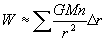
where the value of r runs from r = R (at the earth’s surface) to  (very far away). As
  tends to zero, we get the
definite integral
tends to zero, we get the
definite integral
