Design of streamlines in fluid dynamics
Consider the case of steady-state incompressible fluid flow in two dimensions.
Using rectangular Cartesian coordinates (x,y) to describe a point in the fluid, let
u and v be the velocities of the fluid in the x and y
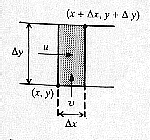
directions respectively. Then by considering the flow in and flow out of a small
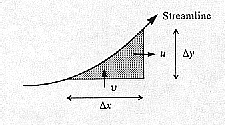
rectangle, as shown below, per unit time, we obtain a differential relationship between u(x,y)
and v(x,y) that models the fact that no fluid is lost or gained in the rectangle;
that is, the fluid is conserved.
Solution:
The velocity of the fluid q is a vector point function. The values of its
component u and v depend on the spatial coordinates x and y.
the flow into the small rectangle in a unit time is  where
where  lies between x and
  , and
, and  lies between y and
  . Similarly, the flow
out of the rectangle is
. Similarly, the flow
out of the rectangle is  where
where  lies
between x and x+
lies
between x and x+ and
and  lies
between y and
lies
between y and  . Because no fluid is created or destroyed
within the rectangle, we may equate these two expressions, giving
. Because no fluid is created or destroyed
within the rectangle, we may equate these two expressions, giving 
Rearranging, we have 
Letting  and
and  gives the continuity
equation
gives the continuity
equation  .
.
The fluid actually flows along paths called streamlines so that there is no flow across
a streamline. Thus from the figure we can deduce that  and hence
The condition for this expression to be exact differential is 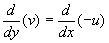 or
or

This satisfied for incompressible flow since it is just continuity equation, so that we
deduce that there is a function  , called the stream function, such
that
, called the stream function, such
that  and
and  . It follows that if we are
given u and v, as functions of x and y, that satisfy the
continuity equation then we can find the equations of the streamlines given by =constant
. It follows that if we are
given u and v, as functions of x and y, that satisfy the
continuity equation then we can find the equations of the streamlines given by =constant
Find the stream function y (x,y) for the
incompressible flow that is such that the velocity q at the point (x,y) is (-y/(x2+y2),
x/(x2+y2)).
Solution:
From the definition of the stream function, we have  and
and  provided that
  . Here we have
 and
and  so that
 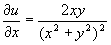 and
and 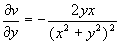 confirming that
  integrating
 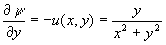 with respect to y, keeping x constant, gives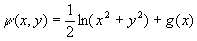
Differentiating partially with respect to x gives 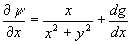
Since it is known that 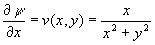 we have
  which
on integration gives g(x) =C where C is a constant. Substituting back into the
expression obtained for
which
on integration gives g(x) =C where C is a constant. Substituting back into the
expression obtained for 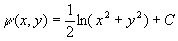
A streamline of the flow is given by the equation  , where k
is a constant. After a little manipulation this gives
, where k
is a constant. After a little manipulation this gives  and
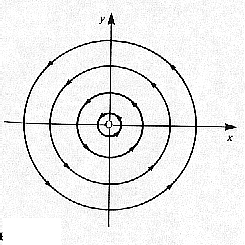
and  and the corresponding streamlines are shown in the given diagram. This
is an example of a vortex.
and the corresponding streamlines are shown in the given diagram. This
is an example of a vortex.